News
Ulcerative Colitis and skin conditions
June 15, 2026
News

Ulcerative colitis (UC) is an inflammatory bowel disease (IBD) that primarily affects the colon, but its effects are not limited solely to the digestive system. Due to the systemic nature of inflammation, many people with UC may develop symptoms outside the intestine, known as extraintestinal manifestations (EIMs). According to the scientific literature, up to 50% of patients with IBD present some type of extraintestinal manifestation, with skin and joint conditions being the most frequent.1,2

Many people are surprised to discover that a flare-up of ulcerative colitis can also manifest on the skin through lesions, ulcers, redness, or persistent rashes. However, science has demonstrated that there is a direct connection between the gut and the skin known as the Gut-Skin Axis.
The gut-skin axis: how are the intestinal microbiota and the skin related?
The most recent research demonstrates that the intestinal microbiome and the skin immune system maintain constant and bidirectional communication.3 This phenomenon is known as the Gut-Skin Axis and explains how intestinal imbalances can trigger skin inflammation.4
When the intestinal microbiota loses its balance, for example due to stress, antibiotics, infections, or certain dietary patterns, the immune system can become excessively activated and produce systemic inflammation.5 This inflammation not only affects the colon, but also other organs, including the skin.
In addition, recent studies published in Nature Communications show that certain immune and microbial alterations can simultaneously modify intestinal function and the cutaneous immune response, reinforcing the idea that the gut and the skin function as closely connected organs.6
This same mechanism is also observed in food allergies. In these cases, the immune system mistakenly identifies certain food proteins as dangerous and releases inflammatory mediators that can produce digestive and cutaneous symptoms, such as vomiting, itching, or rashes.4
How can you tell if a skin lesion is related to IBD?
Not all skin rashes in people with ulcerative colitis are related to inflammatory bowel disease. Professor Shomron Ben-Horin, Head of Gastroenterology at Sheba Medical Center and an international expert in IBD, explains that many patients confuse common or temporary rashes with extraintestinal manifestations.7
According to Ben-Horin, most skin lesions associated with IBD usually:
- Coincide with an active flare of intestinal disease.
- Persist for several days or weeks.
- Present obvious inflammation or pain.
In contrast, a mild rash that appears for one or two days and disappears spontaneously is probably not related to ulcerative colitis.7
Main skin conditions associated with ulcerative colitis 1,2,8
Erythema nodosum
Erythema nodosum is one of the most frequent skin manifestations in patients with UC.9 It is characterized by the appearance of reddish, raised, warm, and painful nodules to the touch and while walking (more painful than intensely itchy), palpable, sensitive, and reddish-purple in color. They generally appear bilaterally on the legs, although they may also affect the thighs, arms, buttocks, or trunk. The nodules usually measure between 1 and 5 cm and change color over time, adopting bruise-like tones before resolving.

In addition, it is estimated that between 5% and 10% of patients with UC will experience it at some point during their disease.
In most cases, erythema nodosum appears during an intestinal flare and improves when digestive inflammation is controlled. More than 80% of patients respond favorably to treatment with corticosteroids or anti-TNF drugs.7,9
Pyoderma gangrenosum
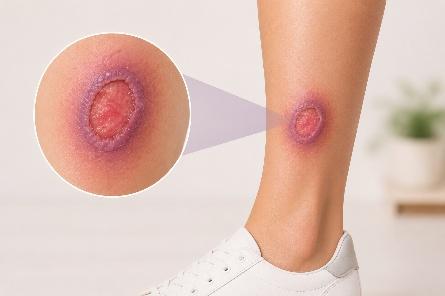
Pyoderma gangrenosum is a much less frequent complication, affecting fewer than 1% of patients, but it is considerably more severe.
This condition causes painful skin ulcers that can grow rapidly.10 It often begins as a small lesion similar to a wound or blister and progresses into a deep ulcer several centimeters wide with violet or bluish borders, frequently on the legs, although it may appear anywhere on the body or around surgical wounds, anywhere on the body or around surgical sites. The lesions may merge if there are multiple ulcers and usually leave scars after healing. Patients may also experience intense pain and, in some cases, joint discomfort.
Unlike erythema nodosum, pyoderma gangrenosum does not always coincide with an intestinal flare and may appear after minor skin trauma or surgery (a phenomenon known as pathergy).
Professor Ben-Horin emphasizes that this condition requires urgent medical attention, although it usually responds well to corticosteroids, anti-TNF agents, or cyclosporine.7 Treatment is usually effective, although the ulcers may leave scars and there is a risk of new lesions appearing in other areas. Early detection and appropriate management are essential to reduce complications, relieve pain, and improve the patient’s quality of life.
Vasculitis
Vasculitis is an inflammation of the blood vessels that may manifest on the skin as reddish or purplish lesions of different sizes.
Although it is not considered a classic extraintestinal manifestation of IBD, patients with ulcerative colitis have a greater predisposition to developing concomitant autoimmune disorders, including vasculitis.
Sometimes, this reaction may be related to viral infections or even to some medications used to treat IBD.
Most lesions are not painful initially, but vasculitis may progress toward severe complications if not treated properly. Therefore, it is recommended to seek medical attention or go to the emergency room quickly if there is any suspicion.
When should I consult a doctor? 7
If you have ulcerative colitis and notice the appearance of:
- Pustules or painful lesions.
- Skin ulcers.
- Persistent reddish nodules.
- Lesions that worsen during an intestinal flare.
it is important to consult a dermatologist or gastroenterologist.1,11
Not all skin rashes are related to IBD. However, if a lesion does not disappear within 1–3 days, progressively worsens, or is accompanied by pain, inflammation, or fever, it is advisable to seek medical attention.
Conclusion
Ulcerative colitis is much more than an intestinal disease. The connection between the gut, the immune system, and the skin demonstrates that systemic inflammation can manifest in different parts of the body. Understanding how the gut-skin axis works helps not only to recognize skin manifestations earlier, but also to understand the importance of keeping intestinal inflammation under control.
The good news is that many of these skin conditions respond favorably to appropriate treatment and control of the inflammatory activity of the disease. Detecting them early and consulting specialized professionals can make a great difference in the quality of life of people with IBD.
Contact UsFor more information
Contact Us